ERVARC News · Volume 1, Issue 1 · November 2026
Welcome to the Elk River Valley Amateur Radio Club!
This is the very first issue of the ERVARC newsletter, and we’re glad you’re here. ERVARC is a brand-new club for licensed hams, future hams and anyone curious about radio in the Elk River Valley. Membership is free. There are no dues. We just ask that you take part when you’re able. Our bylaws have been adopted, our website is live, and we’re ready to get on the air together.
Our Founding Officers
Thanks to the founding officers who got the club started:
| Office | Name | Call Sign |
|---|---|---|
| President & Club Station Trustee | Jason Wills | KO4DDG |
| Vice President | Joe Oddo | KR4HVS |
| Secretary | Chris Turner | N9XC |
| Treasurer | Jerry Wall | KR4HFR |
Haven’t signed up yet? Fill out the one-minute membership application.
Mark Your Calendar
| Date | Event | Where |
|---|---|---|
| Sat, Nov 7 · 8:00 AM | Monthly club meeting (breakfast) | Park City Cafe |
| Sat, Nov 21 · 11:00 AM | License exam session (free) | Park City Cafe |
| Sat–Sun, Jan 23–24, 2027 | Winter Field Day | Announced on Discord & Facebook |
Get Licensed or Upgrade: Saturday, November 21
Our VE team is holding a license exam session on Saturday, November 21 at 11:00 AM at Park City Cafe. Exams are given through the Laurel VEC, and testing is free. All license classes are offered: Technician, General and Amateur Extra.
Bring with you
- Your FCC Registration Number (FRN). Get one free in the FCC CORES system before exam day
- A photo ID
Study free at HamStudy.org. For questions or to reserve a seat, contact Jason Wills (KO4DDG) at Jason@ko4ddg.com or visit mtvett.com. Know someone who has been thinking about getting licensed? Bring them along!
Contest Corner
Contests are one of the fastest ways to fill your log, work new states and practice your operating. You don’t have to be competitive: a handful of contacts helps the serious contesters and is great practice. Here are some highlights from the WA7BNM Contest Calendar for the coming week. Times are UTC, with Central time in parentheses.
| Contest | When | Good for |
|---|---|---|
| YBDXPI FT8 Contest | 0000Z Nov 7 – 2359Z Nov 8 (Fri 6 PM – Sun 5:59 PM CST) | Digital-mode operators: easy FT8 contacts all weekend |
| ARRL Sweepstakes, CW | 2100Z Nov 7 – 0300Z Nov 9 (Sat 3 PM – Sun 9 PM CST) | One of the biggest US contests: work all 80+ ARRL/RAC sections |
| IPARC Contest, SSB | 0600Z – 1800Z Nov 8 (Sun midnight – noon CST) | Phone operators looking for DX |
| K1USN Slow Speed Test | 0000Z – 0100Z Nov 9 (Sun 6 – 7 PM CST, Nov 8) | New CW operators: slow, friendly code |
| Worldwide Sideband Activity Contest | 0100Z – 0159Z Nov 10 (Mon 7 – 8 PM CST, Nov 9) | A quick one-hour SSB sprint |
| VHF-UHF FT8 Activity Contest (NA) | 0000Z – 0500Z Nov 12 (Wed 6 – 11 PM CST, Nov 11) | Technicians: 6 m and 2 m FT8 count! |
Coming up: ARRL Sweepstakes, Phone, is the weekend of November 21–22, the same day as our exam session. Newly licensed Technicians can join in on 10-meter SSB (28.300–28.500 MHz). See our Contests page for the full, current list.
Build It: A 40-Meter NVIS Dipole
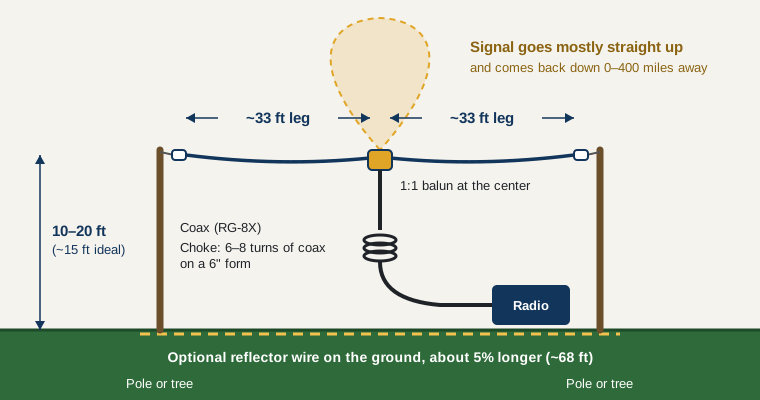
Want reliable contacts across the region, out to about 400 miles, without a tall tower? Try NVIS (Near Vertical Incidence Skywave). Instead of shooting your signal toward the horizon, a low antenna sends it nearly straight up. The ionosphere bounces it back down in a wide circle around you, filling in the “skip zone” that normal antennas jump over. It’s the go-to antenna for emergency and regional nets, and it’s about the easiest HF antenna you can build.
What you need
- About 70 feet of wire: 14-gauge stranded copper (insulated is fine)
- A 1:1 current balun or center insulator. Or make a choke from 6–8 turns of coax wound on a 6-inch form (a piece of PVC works)
- Two end insulators (dog-bone insulators, or cut pieces of PVC)
- 50 feet of coax, RG-8X or RG-58, with PL-259 connectors
- Rope or paracord, plus two supports: trees, fence posts or fiberglass poles
- An SWR meter or antenna analyzer (your radio may have one built in)
Build steps
- Cut two legs, each 34 feet long. The usual formula, 468 ÷ 7.2 MHz, gives 65 feet total, or 32.5 feet per leg. Cut them a little long so you can trim later.
- Attach one leg to each side of the balun or center insulator, and connect the coax.
- Tie an end insulator to the far end of each leg, then tie rope to the insulators.
- Raise it 10 to 20 feet high. About 15 feet is a good target. Run it fairly straight and level. A slight sag is fine.
- Optional: lay a second wire about 68 feet long on the ground directly under the dipole. This “reflector” can add a little extra upward signal.
- Check the SWR around 7.200 MHz. If the lowest SWR is below where you want it, shorten both legs by the same amount, about 3–6 inches at a time. Folding the extra wire back on itself works as well as cutting. Low antennas usually need a bit of trimming. Aim for an SWR under 2:1.
Tips
- NVIS on 40 m works best in the daytime, when the ionosphere’s critical frequency (foF2) is above about 7 MHz. Check the live foF2 map on our Band Conditions page. At night, or when foF2 is low, an 80-meter version (about 65 feet per leg) works better.
- Mount it horizontally. Height matters more than direction for NVIS, so don’t worry about which way it points.
- License note: General and Extra operators can use phone on 40 m (7.125–7.300 MHz). Technicians have CW privileges at 7.025–7.125 MHz.
⚠️ Safety first: keep every part of the antenna well away from power lines, including while you raise it. The wire ends carry high RF voltage when you transmit, so mount them above head height or out of reach, especially where kids, pets or visitors could touch them.
Build one and bring your results, or questions, to the next meeting or our Discord. We’d love to hear who you worked!
Stay Connected
- Chat with members on our Discord server and Facebook group
- Email the club at elkrivervalleyamateurradioclub@gmail.com
- No radio yet? Try QSO One to join nets from your phone or computer
- Have a story, project or photo for the next issue? Send it in!
73, and see you on the air!
— The ERVARC Officers