
Current HF propagation and space-weather conditions, updated automatically from live data sources. Use them to choose the band most likely to be open right now.
Solar & Space Weather
Live data from NOAA Space Weather Prediction Center. Checked …, refreshes every 10 minutes. Green is good, gold is fair, red is poor.
Current HF & VHF Band Conditions
The panel below shows calculated day and night conditions for each HF band group, plus VHF openings. It updates hourly.
Maximum Usable Frequency (MUF) Map
The highest frequency that will reflect off the ionosphere for a 3,000 km path. Bands below the MUF in your area are likely open for long-distance contacts. Bands above it will pass through the ionosphere and be lost to space.

Critical Frequency (foF2) / NVIS Map
The highest frequency that reflects straight back down. When foF2 is above 7 MHz, 40 m works for close-in Near Vertical Incidence Skywave (NVIS) contacts within a few hundred miles. When it is lower, use 80 m or 60 m.

HF Absorption (D-RAP)
Shows where solar X-rays and protons are absorbing HF signals on the sunlit side of the Earth. Colored areas mean weaker signals or blackouts, mostly on the lower bands.

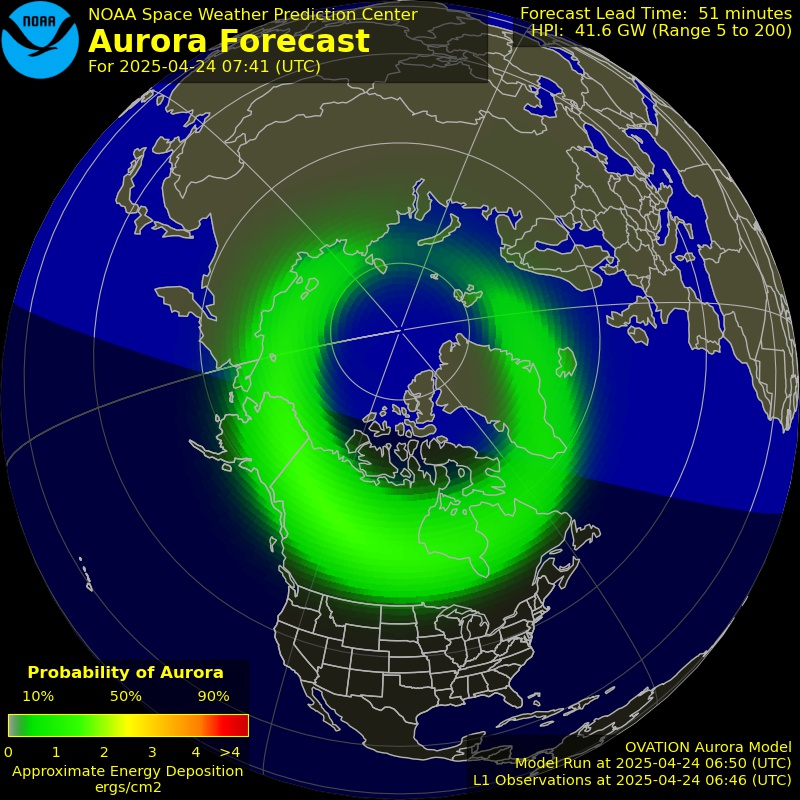
Aurora Forecast
Strong aurora disrupts HF paths that cross the polar regions. It can also make VHF aurora contacts possible on 6 m and 2 m.
Amateur Band Guide (160 m – 6 m)
Typical behavior of each US amateur HF band. Actual conditions depend on the solar cycle, season and the live data above.
| Band | Frequencies (MHz) | Daytime | Nighttime | Notes |
|---|---|---|---|---|
| 160 m | 1.800 – 2.000 | Local only (absorbed) | Regional; DX in winter | High noise, best on winter nights |
| 80 m | 3.500 – 4.000 | NVIS, out to ~300 mi | Regional to DX | Popular for nets and ragchews |
| 60 m | 5 channels near 5.3–5.4 | NVIS regional | Regional | Channelized, 100 W PEP; good for emergency comms |
| 40 m | 7.000 – 7.300 | Regional, out to ~500 mi | Worldwide DX | Workhorse band, open year-round |
| 30 m | 10.100 – 10.150 | Regional to DX | DX | CW and digital only, 200 W limit |
| 20 m | 14.000 – 14.350 | Worldwide DX | Open into evening when SFI is high | The main DX band |
| 17 m | 18.068 – 18.168 | DX | Usually closes after dark | No contests, relaxed operating |
| 15 m | 21.000 – 21.450 | DX when SFI is above ~100 | Usually closed | Excellent near solar maximum |
| 12 m | 24.890 – 24.990 | DX with higher solar flux | Closed | Follows 10 m and 15 m |
| 10 m | 28.000 – 29.700 | DX when SFI is high; Sporadic-E in summer | Closed | Technicians have SSB privileges at 28.3–28.5 |
| 6 m | 50.000 – 54.000 | Sporadic-E in summer; F2 near solar peak | Occasional | “The Magic Band”: sudden openings |
Shortwave Listening (SWL) Broadcast Bands
International broadcast bands for shortwave listeners. Lower-frequency bands are best at night, and higher ones during the day.
| Band | Frequencies (kHz) | Best Time |
|---|---|---|
| 120 m | 2300 – 2495 | Night (tropical/regional) |
| 90 m | 3200 – 3400 | Night (tropical/regional) |
| 75 m | 3900 – 4000 | Night |
| 60 m | 4750 – 5060 | Night (tropical/regional) |
| 49 m | 5900 – 6200 | Night, year-round |
| 41 m | 7200 – 7450 | Evening and night |
| 31 m | 9400 – 9900 | Evening and night, the busiest band |
| 25 m | 11600 – 12100 | Day and evening |
| 22 m | 13570 – 13870 | Daytime |
| 19 m | 15100 – 15800 | Daytime |
| 16 m | 17480 – 17900 | Daytime |
| 15 m | 18900 – 19020 | Daytime |
| 13 m | 21450 – 21850 | Daytime, high solar flux |
| 11 m | 25670 – 26100 | Daytime, solar maximum |
Understanding the Numbers
- Solar Flux Index (SFI): radio energy from the sun at 10.7 cm. Higher is better for HF. Above 100 opens the upper bands, and above 150 is excellent.
- K-index (Kp): geomagnetic disturbance over the last 3 hours, on a scale of 0–9. 0–2 is quiet and best for HF, 4 is active, and 5 or higher is a storm that degrades HF.
- A-index: daily average of geomagnetic activity. Below 10 is quiet. Above 30 means disturbed conditions.
- Solar wind & Bz: fast solar wind (above 500 km/s) and a southward (negative) Bz can trigger geomagnetic storms.
- X-ray flux: solar flare class (A, B, C, M, X). M- and X-class flares can black out HF on the sunlit side of the Earth for minutes to hours.
- MUF: the highest frequency that will bounce back to Earth over a given path. Operate just below it for the best long-distance signals.
Data sources: NOAA SWPC, N0NBH (hamqsl.com), and KC2G. Thanks to these providers for making their data freely available.